Play Tetris Attack Online
Game Info
4 / 5
34 votes
- Platform
- SNES
- Genres
- Puzzle
- Player Perspective
- Side view
- Developers
- Nintendo R&D1 · Intelligent Systems
- Publishers
- Nintendo · Playtronic
- Release date
- August 1, 1996
- Languages
- 🇬🇧 🇺🇸 English · 🇯🇵 Japanese
Summary
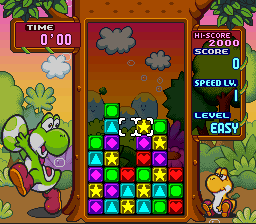
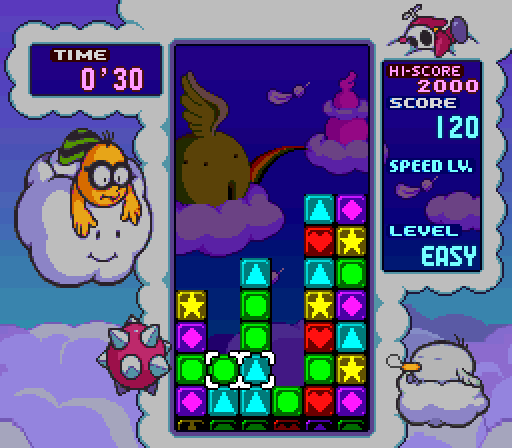
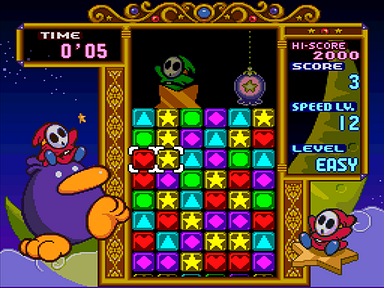
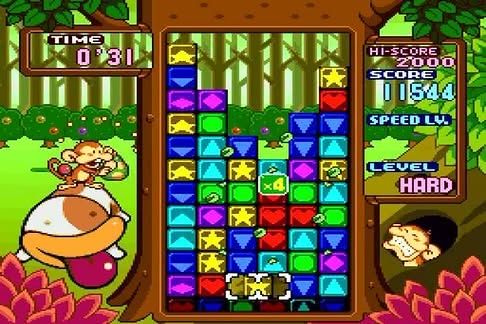
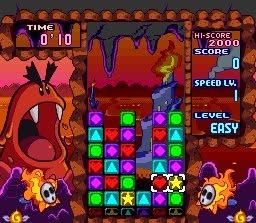
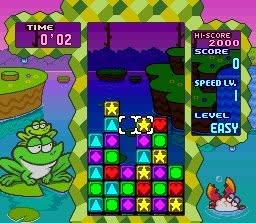
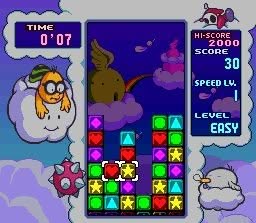
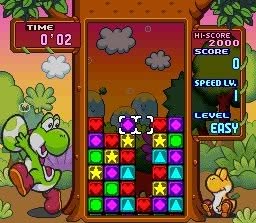
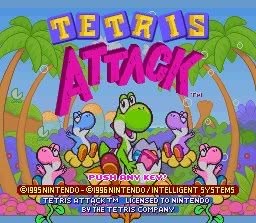
Tetris Attack, called Panel de Pon in its Japanese home, launched as the inaugural entry of the Puzzle League series on the Super Nintendo and later on Game Boy. The original Japanese version featured whimsical fairies and a fantasy backdrop, but the Western release swapped those assets for the familiar faces of Super Mario World 2: Yoshi’s Island, turning the game into a recognizable Mario‑themed puzzle experience.
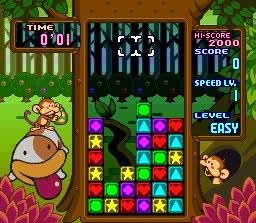
The core loop revolves around swapping adjacent blocks with an on‑screen cursor to line up three or more of the same colour. When a line clears, any blocks above fall and can trigger chain reactions, while the entire stack slowly rises from the bottom, forcing the player to stay ahead of the top. Multiple modes keep the formula fresh: a story‑driven ladder of AI opponents, endless survival, a two‑minute timed sprint, stage‑clear challenges that hide a boundary line, and a puzzle mode that freezes the rising stack for set‑move solutions, plus a robust two‑player battle.
Intelligent Systems handled the design under the watchful eye of Gunpei Yokoi, and despite the Tetris branding the game bears no mechanical ties to the classic tetromino title—a fact that later Tetris co‑founder Henk Rogers regretted, saying the name caused it to "get lost in history." The title’s Japanese identity, Panel de Pon, remained intact for the Satellaview broadcast in 1998, where it appeared as BS Panel de Pon – Event '98, while the Yoshi‑themed version aired as BS Yoshi no Panepon.
Critics responded with near‑universal praise, awarding it scores in the high‑80s to 90s and crowning it Electronic Gaming Monthly’s SNES Game of the Year, Hand‑Held Game of the Year, and Puzzle Game of the Year. Reviewers highlighted its bright graphics, addictive depth, and especially the two‑player mode that could turn a friendly match into a frantic battle of garbage blocks.
The game’s DNA lives on through a string of Puzzle League sequels that borrowed Pokémon, Dr. Mario and other Nintendo mascots, and its musical and visual motifs have resurfaced in the Super Smash Bros. series, Animal Crossing: New Leaf, and even a dedicated minigame in the 2016 Animal Crossing update. Its legacy proves that a simple block‑matching puzzle, when dressed in the right characters and polished with tight design, can become a timeless staple of retro gaming.
Storyline
*Tetris Attack* originally launched in Japan as *Panel de Pon* in October 1995, starring a cast of fairies in a mythical fantasy world. When the game was localized for the West in 1996, the fairy setting was swapped for the colorful characters and backdrop of *Super Mario World 2: Yoshi’s Island*. The core gameplay remained the same, but the story mode now unfolds on Yoshi’s Island. In the Western version, Bowser and his minions have cursed all of Yoshi’s friends, and the player takes control of Yoshi to free them one by one. Defeating each cursed friend lifts the spell, after which the player faces a succession of Bowser’s minions and finally Bowser himself. During these final battles the player may choose Yoshi or any of his rescued friends, each battling against computer‑controlled opponents.
Edited by Maya Carter
Game Videos
Game Screenshots
Multiplayer
- Multiplayer setup
- Split Screen
External Links
You might also like
The Hunt for Red October
1993 Action
Metal Combat: Falcon's Revenge
1993 Action