Play Sands of Destruction Online
Game Info
3.9 / 5
1 vote
- Platform
- Nintendo DS
- Genres
- Role-Playing
- Player Perspective
- Top-down
- Developers
- Imageepoch
- Publishers
- Sega
- Release date
- September 25, 2008
Summary
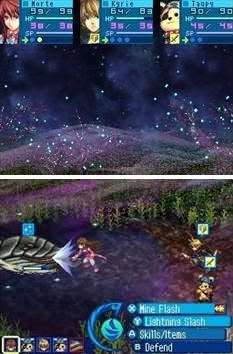
Sands of Destruction surprised me with its ambitious two‑screen battle system, where ground foes occupy one DS screen and aerial enemies the other. Exploration feels like a classic top‑down RPG, but the combat mixes turn‑based commands with real‑time timing, letting you chain attacks, trigger special moves, and even finish a round with a quick‑time event. The party’s Battle Points and hidden morale add a layer of resource management that keeps each encounter feeling fresh.
The development team at Imageepoch enjoyed unusually broad creative freedom because Sega wasn’t known for DS RPGs. Writer Masato Kato deliberately flipped the usual hero‑saves‑the‑world trope, and the original script was far darker before it was softened for a younger audience. Artists Kunihiko Tanaka and Kimihiko Fujisaka gave the characters a distinctive look, while the decision to use a two‑gigabit cartridge allowed the game to blend 3D environments, rotating camera angles, and nostalgic 2D sprites.
Music is where the game truly shines. Yasunori Mitsuda, along with Shunsuke Tsuchiya and Kazumi Mitome, crafted a score that ranges from sweeping orchestral pieces performed by the Czech Philharmonic Collegium to memorable vocal tracks. The Japanese opening "Crash" by pop group AAA was swapped for a new theme in the Western release, a change the producers felt would better suit overseas listeners.
Critics were split. Reviewers praised the combat’s inventive blend of mechanics and the soundtrack’s richness, but many noted uneven difficulty spikes and a relatively short playtime. Graphics were lauded for pushing the DS’s limits, even if the visual polish didn’t match console standards. Voice acting received a nod for quality, though some felt the delivery was hit‑or‑miss.
Beyond the game, Sands of Destruction launched as part of a three‑part multimedia push, spawning a Production I.G anime and a Dengeki Maoh manga. Both adaptations kept the core premise but explored different narrative angles, giving fans a broader look at the desert‑world setting.
Storyline
Sands of Destruction takes place on a desert world that repeatedly cycles through destruction and rebirth, driven by an ancient force known as the Destruct Code and guarded by four Primal Lords. The planet’s inhabitants are split between humans and anthropomorphic Ferals, the latter ruled by twelve Beast Lords who treat humans as slaves. In response, two human‑centric factions arise: the World Annihilation Front, which seeks the Destruct Code to end the world, and the Golden Lions, who oppose the Ferals but aim to preserve the world. The Beast Lords counter by forming the World Salvation Committee to protect the current order.
The story follows Kryie, an orphaned, peace‑loving youth from the village of Barni, where humans and Ferals live as equals under Beast Lord Ursa Rex. After a mysterious voice turns Barni into sand, Kryie is rescued by Morte, a cheery but radical member of the World Annihilation Front who wants to destroy and restart the world. They are joined by Agan Mardrus of the Golden Lions, the dragon‑blooded Rhi’a Dragunel, the teddy‑bear‑looking Feral bounty hunter Taupy, and half‑Feral Naja Gref, who initially hunts the Front. Guided by the Front’s hidden leader, the group battles two Primal Lords so Kryie can gain their power while the World Salvation Committee sends Naja to stop them.
As the conflict escalates, Kryie learns his destiny as the "Destruct" and confronts the Crimson Sun, a Primal Lord masquerading as his uncle. After a series of betrayals and sacrifices, Morte uses her love to restore Kryie’s human form, and together they reject the Creator’s plan for endless cycles. With the final Primal Lord’s blessing, they defeat the secret founder Lacertus Rex and the artificial Creator, then reshape the world into a thriving land where humans and Ferals can coexist peacefully.
Edited by Maya Carter