Play Tetris Online
Game Info
4 / 5
275 votes
- Platform
- NES
- Genres
- Puzzle
- Developers
- Nintendo R&D1
- Release date
- November 1, 1989
Summary
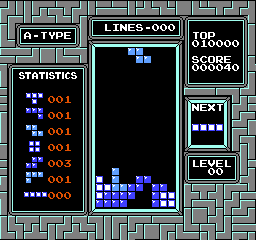
The NES version of Tetris offers two distinct play styles. In A‑Type you chase the highest score while the level climbs every ten cleared lines, speeding the fall of each tetromino. B‑Type drops a pre‑set wall of random obstacle blocks at the bottom and challenges you to clear exactly twenty‑five lines without the level ever changing. A preview window shows the next piece, and a side panel even tallies how many of each shape have appeared so far. Scoring rewards the classic "tetris"—four lines cleared with the long I piece—far more than single or double clears, because each line’s base points are multiplied by one plus the current level. As you ascend, the game’s colors shift and the pace quickens until level 29, where pieces drop one cell per frame, creating the infamous "kill screen" that the developers never intended anyone to survive. If you manage a massive score, the ending animates a rocket launch in front of Saint Basil’s Cathedral, ranging from a bottle rocket to the Buran spaceplane, and a UFO can even appear in the best outcome. Under the hood, the game uses a 16‑bit linear‑feedback shift register for pseudo‑random piece selection, which subtly under‑represents the I piece in every 224‑piece cycle. At extreme levels the code glitches: level 138 triggers palette corruption, levels 146 and 148 turn the pieces black against a black background, and clearing around 1 550 lines can crash the score counter. Surpassing level 255 would wrap the level counter back to zero—a "rebirth" that most players never see because an underflow at 2 190 lines stalls progression until another 810 lines are cleared. Because the NES’s delayed‑auto‑shift forces a 16‑frame pause before a piece repeats its horizontal move, high‑level players resort to "hypertapping"—tapping the D‑pad faster than ten times a second—or the more exotic "rolling" technique, which can shift pieces up to thirty times per second. All of this plays to a soundtrack of Russian classics, featuring Tchaikovsky’s Sugar Plum Fairy and Bizet’s Carmen overture, giving the game a surprisingly elegant backdrop.
Edited by Maya Carter