Spirou
Platformer

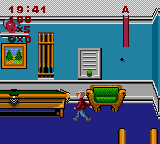
Home Alone on the Game Gear blends a top‑down sled‑riding map with side‑scrolling combat, letting you zip between neighbourhood houses while the Wet Bandits roam in their van. The core loop revolves around a Pain Meter that fills as you knock the burglars back with a quirky arsenal you can cobble together—BB guns, glue‑filled rockets, snow‑ball launchers, even light‑bulb grenades. Each weapon type has its own trajectory, from long‑range rifles to high‑arc mortars, and you can break them down for ammo to repurpose in new creations. Two difficulty settings crank the pressure: the hard mode stretches the police‑arrival timer to 40 minutes and speeds up the bandits’ van, but rewards you with more powerful gear. If a house gets “flooded” you lose access to it, adding a strategic layer to where you set traps and which weapons you prioritize. The game’s blend of resource‑crafting, timed defense and fast‑paced platform action makes the handheld version a surprisingly deep tie‑in to the classic film.
Home Alone on the Game Gear follows the same basic premise as the film: Kevin McCallister is accidentally left behind when his family jets off to Paris for Christmas. In this version Kevin must stop the bumbling burglars Harry and Marv – the Wet Bandits – from breaking into homes in his neighborhood while he waits for the police to arrive. The gameplay revolves around setting up household objects as traps and weapons to fend off the intruders. Unlike the Super NES edition, which has Kevin ferrying family valuables down a chute to a basement safe, the Game Gear (and Genesis) storyline focuses on defending multiple houses and confronting the Wet Bandits as they try to loot them. The goal is simply to survive long enough for help to show up.
Edited by Maya Carter
Platformer
1993 Platformer
1994 Action
1994 Action