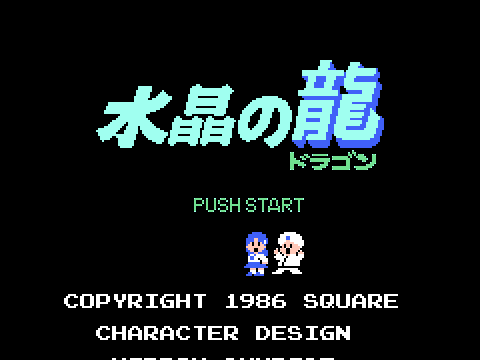
Suishou no Dragon
1986 Graphic Adventure
When Nintendo needed a Western sequel that wouldn’t frustrate players, they turned a quirky Japanese advergame into the version we know as Super Mario Bros. 2. The original Famicom Disk System title, Yume Kǒjǒ: Doki Doki Panic, was built around the mascots of Fuji Television’s 1987 tech expo, and its core mechanics – picking up and throwing enemies, vertical scrolling sections, and the iconic POW block – survived the conversion almost untouched. By swapping the festival’s family of characters for Mario, Luigi, Princess Toadstool and Toad, the R&D4 team gave the brothers their first noticeable height difference and gave Luigi his signature leg‑scuttle animation to justify his higher jumps.
Gameplay feels like a dream‑world sandbox rather than a straight‑line platformer. Players choose one of the four heroes, each with a distinct blend of speed, strength and jump height, then wander through Subcon’s twenty levels, which can scroll left‑to‑right, right‑to‑left, or even vertically. Instead of stomping foes, you lift and hurl them – or toss vegetables and mushroom blocks – to clear a path, while power‑ups like the stopwatch or the star‑granting cherries add a playful tactical layer. The lack of a timer and the ability to explore Sub‑space for hidden coins and health‑boosting mushrooms make the experience feel surprisingly relaxed for a Mario title.
The game’s release history is a little knotty. After its 1986 debut on the Famicom Disk System (later rebranded as Super Mario Bros.: The Lost Levels), Nintendo of America rejected it, prompting the Doki Doki Panic conversion in 1988. Japan later re‑issued the same Mario‑skin version as Super Mario USA in 1992, and it resurfaced in the Super Mario All‑Stars collection (1993) and Super Mario Advance (2001), eventually joining Virtual Console and Nintendo Classics.
What sticks with me most is how the developers embraced the “anything goes” philosophy Miyamoto championed. They kept the original’s quirky charm, trimmed the mandatory use‑of‑all‑characters requirement, and added a simple run button, turning a prototype that once seemed too complex for the hardware into a beloved, off‑beat entry that still feels fresh decades later.
In Super Mario Bros. 2 for the Famicom Disk System, Mario dreams of a towering staircase that leads to a mysterious door. A disembodied voice tells him the world beyond is the dreamland of Subcon and begs for his help against Wart, a tyrannical frog who has cursed the realm. Mario awakens, shares the vision with Luigi, Toad and Princess Toadstool, and discovers they all experienced the same dream. The quartet sets out on a picnic, stumbles upon a cavern with a long staircase, and climbs through the door at its summit, finding themselves truly inside Subcon. After battling and defeating Wart, the inhabitants are liberated, a celebration erupts, and Mario suddenly finds himself back in his bed, uncertain whether it was all a dream before he drifts off to sleep again.
Edited by Maya Carter
1986 Graphic Adventure
1988 Platformer