Play Renegade Online
Game Info
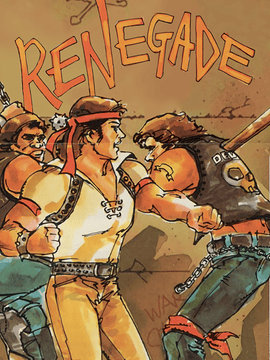
4.2 / 5
20 votes
- Platform
- Arcade
- Genres
- Beat 'em Up
- Player Perspective
- Top-down
- Developers
- Technos Japan
- Publishers
- Taito
- Release date
- December 1, 1986
Summary
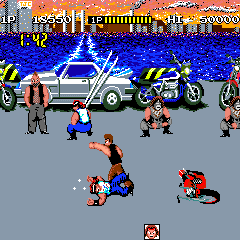
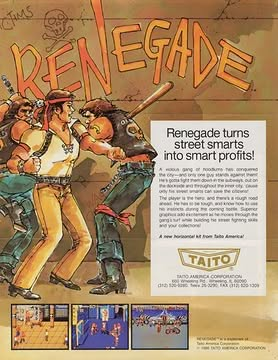
Renegade feels like a stripped‑down Double Dragon II that trades sprawling battlefields for tight, three‑screen arenas that keep the action relentless. The game’s isometric view lets you dash forward, back, and even into the background, while a simple three‑button layout—punch, kick, jump—unleashes combos, throws, and even a brutal rain of punches on a downed foe. I love the way you can grab a stunned enemy by the collar and kick him repeatedly, or slam a fallen opponent with a shoulder throw; the mechanics feel surprisingly deep for a 1986 arcade title. Technos re‑skinned the original Japanese high‑school brawler Nekketsu Kouha Kunio‑kun with a gritty, "Warriors"‑inspired aesthetic for Western audiences, swapping school uniforms for street‑wise thugs and adding speech bubbles that give the game a colorful, comic‑book vibe. The hardware combo of a 6502 CPU, a 68705 microcontroller, and a 6809 sound chip helped keep the action smooth, avoiding the slowdown that plagued many contemporaries. Beyond the arcade cabinet, Renegade made its way onto the Spectrum, Amstrad, Commodore 64 and later the Amiga, thanks to Imagine/Ocean’s conversions. Those ports even spawned unofficial sequels like Target: Renegade (1988) and Renegade 3, The Final Chapter (1989), cementing its cult status long after the original streets of the subway, harbor and alley faded into retro legend.
Storyline
Renegade drops you onto a grim subway platform at 2 A.M., where a gang of punks armed with clubs, chains and blades is waiting. You play as a street brawler who must battle through four distinct stages of thugs to reach the mob boss and rescue his kidnapped girlfriend, ending the showdown with a kiss as she thanks him. The final confrontation takes place in the boss’s hideout, and defeating him lets the hero walk out into the night with his love.
The original Japanese arcade version, Nekketsu Kouha Kunio‑kun, swaps the romance plot for a high‑school delinquent story. Here the protagonist is Kunio, who fights rival school gangs that are harassing his classmate Hiroshi, not a damsel. Sprites were altered for the Western release: the train‑station level became a subway, the student characters were redrawn as street thugs, and the brother figure was replaced by a female hostage.
Both versions share the same side‑scroll beat‑’em‑up mechanics and four gang‑filled stages, but the cultural rewrite changes the motivation—from rescuing a girlfriend to defending a friend and school honor.
Edited by Maya Carter
Game Screenshots
Game Artworks
Arcade Machine
- Developers
- Taito
- Machine Style
- Upright
- Control Panel
- Single-player
- Input Devices
- Joystick · Buttons
- Screen Orientation
- Landscape
- Sound
- Mono
Multiplayer
- Multiplayer setup
- Hot Seat